Discover. Learn. Rock on.
Bring your students to the Rock & Roll Hall of Fame and experience the power of music to inspire learning.
Our engaging, standards-connected onsite programs bring history, culture, and creativity to life – all in an unforgettable setting.
Field trip program offerings for the 2026-2027 school year are listed below. The request form for booking a field trip to the Rock Hall is now live! We welcome you to review the program options and book your trip soon!
We look forward to hosting you and your students!
Field trips at the Rock & Roll Hall of Fame and Museum take place most Tuesdays-Fridays, running mid-October through the end of May. Field trip programs will take place in two main spaces:
-
Foster Theater (Level 4)
-
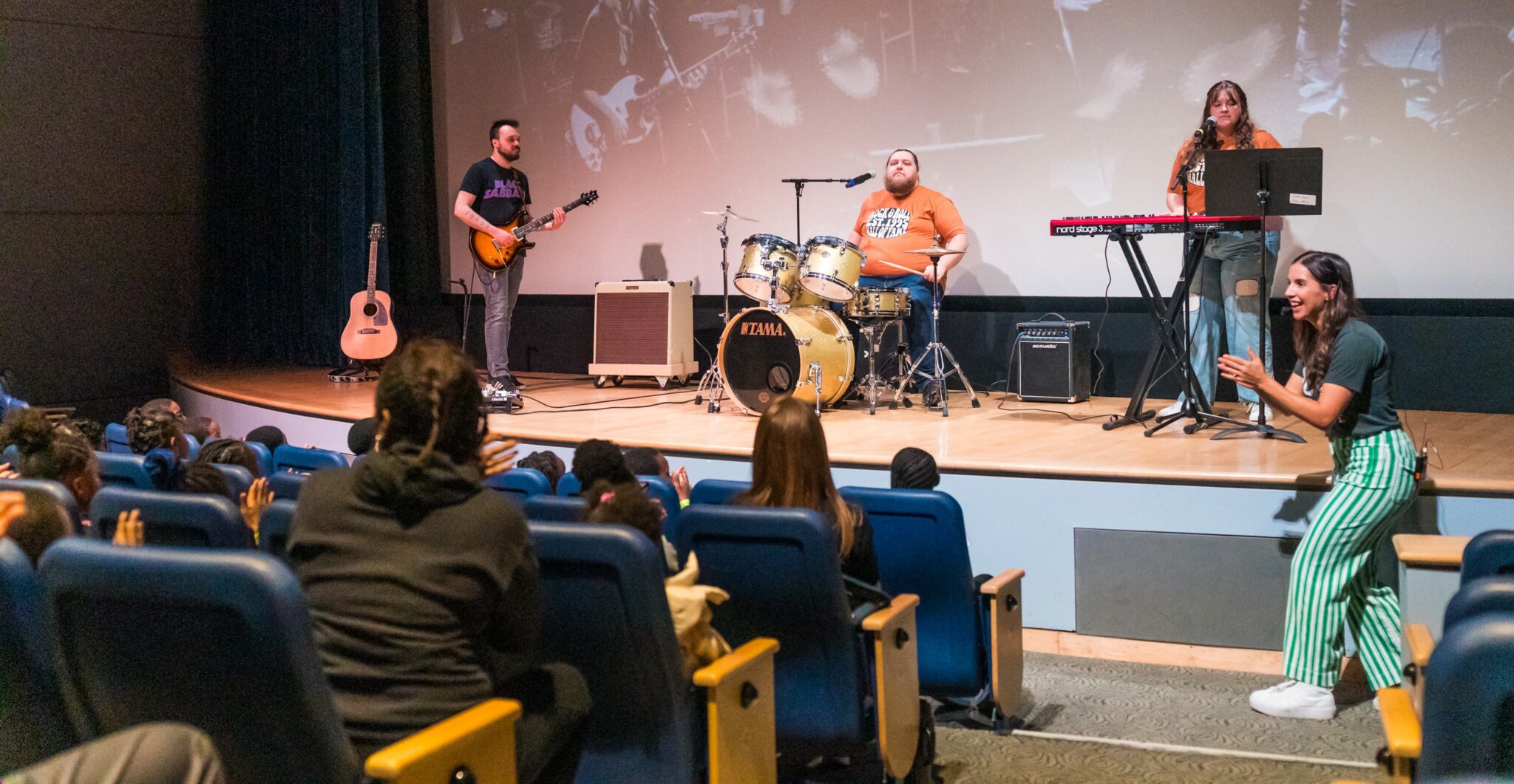
Groups up to 140 students, taught presentation-style and featuring group engagement, multimedia tools, and exclusive Rock Hall content
-
-
Howley Family Education and Community Center Classroom Space (Level 0)
-
Groups of 40 or less, taught workshop-style, featuring hands-on exploration and collaborative learning. Classes in the Howley Center begin in January 2027.
-
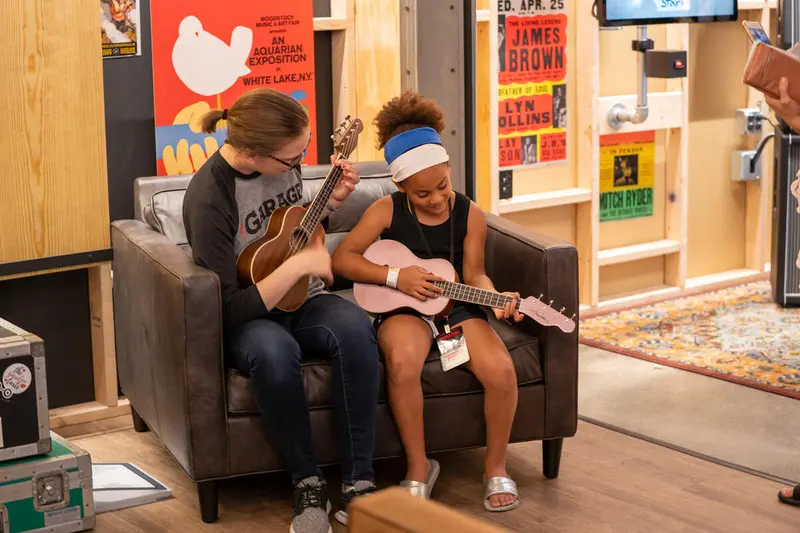
All programs are offered during morning hours, with arrival times between 9:15am and 10:15am, depending on scheduled program time (see additional information below). The Rock Hall will provide all groups with a visit schedule that includes scheduled times for the educator-led program, self-guided museum explorations, and dedicated time in our popular Garage exhibit.
Please click below to use our intuitive booking system to schedule your trip. If you have a group or trip that does not fit into the options on the form (ex. very small or very large group, booking more than one program, or multiple visits), please reach out directly to edu@rockhall.org.
Additional Information is listed below.
2026-2027 Field Trip Program Offering
2026-2027 Field Trip Program Offering
This engaging, hands-on music class introduces learners to four elements of music—rhythm, pitch, tempo, and dynamics—by exploring musical opposites! Students will use instruments, movement, and listening examples to understand how musicians use opposites to create music. Students will use rhythm sticks to play long and short rhythms, move their bodies fast and slow, sing high and low pitches, and use their motor skills to play instruments loudly and quietly. Students will also be introduced to real-life music vocabulary and notation, including quarter notes and eighth notes, crescendo and decrescendo symbols, and tempo markers.
- After participating in this program, students will be able to:
-
- Identify musical opposites when listening to music.
-
- Demonstrate musical elements with classroom instruments.
-
- Follow basic musical roadmaps using visual and pictorial supports.
How are our favorite songs brought to life? This engaging program introduces students to the core instruments that power rock & roll: percussion, strings, keyboards, and voice. Through dynamic live and video demonstrations, instructors will demonstrate how each instrument produces sound, how its sound can be changed or amplified, and how each instrument plays a unique role in a band. Along the way, students will hear musical examples that showcase how each instrument stands out and supports the overall sound of a song. By the end, students will understand how instruments work together in a band to bring their favorite songs to life.
- After participating in this program, students will be able to:
-
- Describe how each instrument creates sound.
-
- Identify ways sound can be changed or amplified.
-
- Explain each instrument’s role in a band and how they create music together.
Rock & roll didn’t appear out of nowhere—it was built on the sounds and stories of earlier American music. In this engaging program, students will explore the roots of rock & roll by listening to and learning about three foundational musical styles: country, gospel, and jazz. They’ll discover how these genres reflect the culture, geography, and everyday life of different regions across the United States—and how together, they sparked a musical revolution.
This program is offered in two formats: in a lecture style in our large Foster Theater, and in a hands-on workshop style (beginning in January 2027) in our smaller education center classroom space, where students will uncover and analyze “artifacts” for each musical style. Through music listening, map reading, and classroom discussion, students will learn how these genres connect to the people, places, and cultures of America.
- After participating in this program, students will be able to:
- Identify musical styles that came before rock & roll.
- Locate where these styles originated across the United States.
- Explain how the geography and way of life in each region helped shape the music.
How do rock bands use vibrations to build their sound? In this exciting program, students will explore the science behind their favorite rock & roll instruments. Students will grow their scientific and musical understanding during hands-on experiments using rock instruments like the acoustic guitar, electric guitar, and snare drum. They will use a virtual oscilloscope to chart waveforms, measure frequency and amplitude of sound waves, and learn how vibrations inform musical concepts like tuning and harmonics. Students will also explore music technology by using a Digital Audio Workstation (DAW) to record instrument sounds, view waveforms, and create their own recorded demo!
- After this program, students will be able to:
-
- Describe and demonstrate how different rock instruments create vibrations.
-
- Explain how frequency and amplitude relate to pitch and volume.
-
- Identify how science and technology contribute to music creation.
The music industry is vast and holds numerous opportunities for a lifelong career. In this engaging program, students will discover the many jobs that exist with music as the focal point, both out in front of the fans and behind the scenes. Students will learn about familiar and unfamiliar career ideas through categories like Musicians, Producers, Storytellers, and Managers. In a choose-your-own-adventure style, students will work together to find a new career path while hearing accounts on the job from Rock Hall Inductees and local professionals.
- After participating in this program, students will be able to:
-
- Name music-centered careers, both onstage and behind the scenes.
-
- Hone their skills and interests to find a career in music they may not know exists.
-
- Research local music careers and discover pathways to more national career opportunities.
In this engaging program, taught in the Howley Center, students will explore Cleveland’s music history to discover why the city earned the title “Birthplace of Rock & Roll.” Students will interact with primary sources and artifacts from the Rock Hall archival collection to answer three key questions: How did Cleveland natives Alan Freed and Leo Mintz change the music industry? How do primary sources tell the story of the first rock & roll concert? Why did touring artists want to perform in Cleveland and be reviewed by Jane Scott?
- After participating in this program, students will be able to:
-
- Describe the contributions of key Cleveland musical figures Alan Freed, Leo Mintz, and Jane Scott.
-
- Use primary source documents to draw conclusions about historical events.
-
- Differentiate between fact and opinion within historical text.
From block parties in the Bronx to global stages, hip-hop has grown into one of the most powerful cultural forces of our time. This dynamic program explores how hip-hop emerged not just as a new sound, but as a bold form of expression born from creativity, community, and resistance in 1970s Bronx.
This program is offered in two formats: in a lecture style in our large Foster Theater, and in a workshop style (beginning January 2027) in our smaller education center classroom space, where students will interact with the four distinct cultures of hip-hop in a hands-on way. Through engaging discussions, multimedia clips, and lyrical analysis, students will learn about the innovative technology behind hip-hop’s earliest beats, the social conditions that gave rise to the movement, and how MCs turned rhymes into rallying cries.
- After participating in this program, students will be able to:
-
- Express how the social and cultural climate of The Bronx in the 1970s contributed to the birth of hip-hop.
-
- Examine music technology, such as turntables and drum machines, that fostered innovation in the hip-hop sound.
-
- Discuss how lyrics became a part of hip-hop and developed into a vessel for delivering powerful messages.
In this engaging program, students will explore the history of Cleveland’s music media and uncover how the city became “The Birthplace of Rock & Roll.” Students will interact with and discuss primary and secondary sources from the Rock Hall archival collection to answer three key questions: How did Alan Freed and Leo Mintz change the music industry in the 1950s? How do primary sources tell the story of rock & roll? What impact did radio and printed media have on Cleveland’s musical landscape in the 20th century?
- After participating in this program, students will be able to:
-
- Explain the contributions of key Cleveland musical figures Alan Freed and Leo Mintz, Jane Scott, and Donna Halper.
-
- Use primary and secondary sources to draw conclusions about historical events.
-
- Differentiate between fact and opinion within historical text.
Music has long served as a powerful tool for protest, expression, and social change. In this engaging, discussion-based program, students will explore how artists have used music to respond to major events and movements throughout modern history.
Using listening and video examples, students will analyze songs from key moments such as the Cold War, the Civil Rights Movement, and the Vietnam War. They’ll examine how artists like Bob Dylan, Mahalia Jackson, and Black Sabbath used lyrics, style, and sound to speak out—and how those messages connect to modern protest music today.
- After participating in this program, students will be able to:
-
- Examine how music is shaped by social and political movements.
-
- Analyze how artists use different musical styles to share powerful messages.
-
- Discuss how protest music continues to evolve while echoing themes from the past.
What exactly goes into building a new class of Rock & Roll Hall of Fame Inductees? In this program, students will learn the process the Rock & Roll Hall of Fame Foundation takes in drafting each year’s inductee classes. They will discover the nomination process and the criteria used for deciding who is eligible for induction. Groups will then nominate, defend, and vote for a mock Inductee class!
In this program, students will use arguments, evidence, and public speaking skills to build a mock nominee group for the class to vote on. Learn what it takes to make your case for some of your favorite artists to get their shot at Induction!
- After participating in this program, students will be able to:
-
- Explain the process of creating a new class of Inductees from the nomination to the ceremony.
-
- Present an argument for someone to be inducted using Influence, Innovation, and Impact criteria.
-
- Support arguments with facts and evidence to build a new Inductee ballot.



Additional Information
Additional Information
- Submit a request form with your school/class information and program/date selection.
- We’ll confirm your visit within a week or reach out to offer alternative dates.
- Once booked, 2 weeks before your visit you’ll receive:
- Visit details & schedule
- Pre-visit materials
- Tickets
Field trips at the Rock and Roll Hall of Fame and Museum take place most Tuesdays-Fridays, running mid October through end of May. All programs are offered during the morning hours, with groups arriving at the Rock Hall between 9:15am and 10:15am, depending on the scheduled program time. Most groups will start their visit with the educational program, with the exception of the 11am program, which will tour exhibits upon arrival. Please make note of the arrival and program times when you are selecting your visit/date.
Program & Arrival Time
- 9:30am Program -> 9:15am Arrival Time
- 10:00am Program -> 9:45am Arrival Time
- 10:30am Program -> 10:15am Arrival Time
- 11:00am Program -> 9:45am Arrival Time (Garage & Main Exhibit Hall explorations prior to program at 11:00am)
The Rock Hall will also provide all groups with a schedule of their visit to ensure students get to see the exhibits throughout the museum that tie to the education program they are attending, as well as have dedicated time to play real instruments in our Garage Exhibit on Level 2, all while maintaining comfortable capacity throughout the museums spaces. A sample visit schedule could look like:
- 9:15am – Arrival
- 9:30am – Program in Foster Theater
- 10:30am – Exhibit Explorations, Levels 3-6
- 11:00am – Exhibit Explorations, Level 2 Garage
- 11:30am – Lunch
- 12:00pm – Exhibit Explorations, Level 0, Main Exhibit Hall
- 12:30pm – Departure
Due to construction related to our building expansion, we are currently unable to provide a guaranteed lunch space for school groups. You may still bring packed lunches and use available tables in our café space or on our outdoor plaza; however, please let us know your lunch plans in advance. Depending on your group’s size, we may ask you to stagger student lunch times due to limited café seating, so that some seating remains available for other museum visitors. Our cafe is not able to accommodate school groups purchasing lunch onsite. Weather permitting, students are welcome to eat outside on the plaza. Thank you for your understanding as we grow our building!
Thanks to the generous support of our sponsors and funders, schools in the following categories qualify for free programming and admission:
- Cleveland Metropolitan School District (CMSD): All CMSD schools, and
-
- We also reimburse CMSD for bussing costs.
- Northeast Ohio schools: Schools with a Northeast Ohio ZIP code (zip codes beginning with 440 through 443)
- Title I-eligible schools: Schools that qualify for Title I Funding
If your school falls into one of these categories, we will note your eligibility on our end, and no further action is needed from you.
If your school does not fall into one of these categories, we will send an invoice with instructions for submitting payment to our Accounting Department. You do not need to purchase tickets online; we will book the tickets for your group from our end.
We require a minimum chaperone ratio of 1 adult for every 10 students for all student visits to the Rock Hall. You may exceed this minimum–one free adult admission is available for every five attending students. Adults exceeding the 1:5 ratio must purchase museum admission separately.
Chaperones are required to stay with students, regardless of grade level, during the entirety of the visit, helping ensure that students explore the exhibits, artifacts and interactives with care.
Our Foster Theater, where our programs currently take place, has a total capacity of 140 students. If you are looking to book groups with more than 140 students, please email us so we can assist with booking multiple programs.
We will be opening a new smaller classroom space in January 2027 in order to provide a more hands-on learning experience for small groups. If you are bringing a group of 40 students or less, please consider booking a “workshop” program during the months of January – May. Smaller groups booked in our larger theater space may get paired with another group for their program.
If you have any questions regarding student capacity please reach out to Edu@rockhall.org
Busses are able to pull up to the Rock Hall along Erie Side Ave to drop off and pick up students, but they are unable to park there during the visit.
Oversized vehicles, like buses, can park at Dock 32 (behind FirstEnergy Stadium), North Coast Harbor Port lot at 101 Erieside, Cleveland, OH 44114 (open daily 5:30 am to 9:00 pm). Daily rates tend to range between $30-$35. You can reach them directly at (216)-781-7489.
Otherwise, there are parking meters around the area and other street parking options around the Great Lakes Science Center. In most of these areas, bus drivers must stay with the buses.